New Post-Quantum Cryptography Standard · AI Agent Security Standard · or both in the Emerging Risks Pack →
Prices in USD · Instant download · Templates in Word and ExcelSupportContact usCart

Shop / Policies & standards

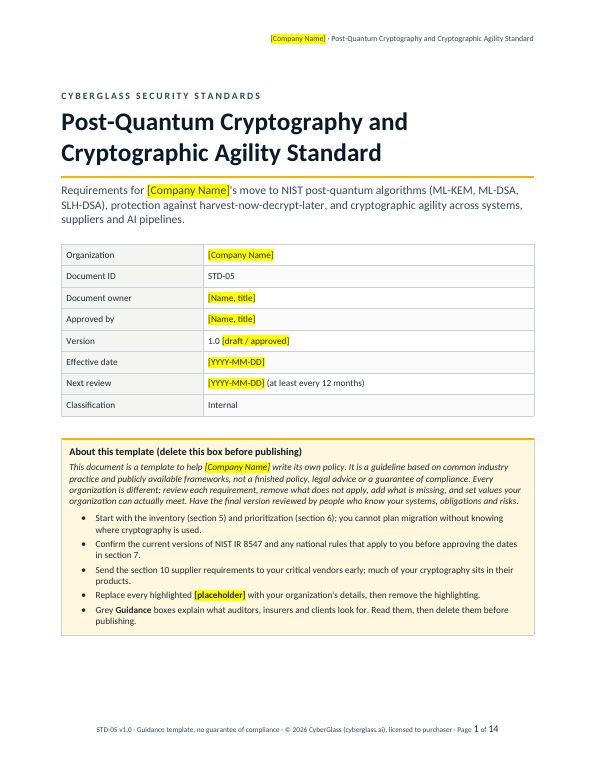
Post-Quantum Cryptography and Cryptographic Agility Standard

Plan your move to post-quantum cryptography (ML-KEM, ML-DSA, SLH-DSA) in plain language: what PQC is, a cryptographic inventory, harvest-now-decrypt-later priorities, hybrid key exchange, 2030/2031/2035 milestones and crypto agility.

First page of Post-Quantum Cryptography and Cryptographic Agility Standard

View sample pages (PDF) ↗

What post-quantum cryptography is, and the deadlines, in plain words →

What's inside

  • Editable Word standard in formal "shall" requirement language
  • Plain-language explanation of what post-quantum cryptography is, what it does and what stays the same
  • Approved and quantum-vulnerable algorithm tables with NIST IR 8547 status
  • Cryptographic inventory and CBOM method, generated in the build pipeline with drift checks, plus prioritization rules for long-lived and archived data
  • Phased milestones (2030 key establishment, 2031 signatures, 2035 disallowance), hybrid key exchange rules and a yearly algorithm rotation exercise
  • Supplier contract terms, PKI and code signing, AI pipeline and AI agent credentials, and exceptions with CISO approval after 2032
  • Regulatory timelines for the US, Canada, UK, EU and Australia, measures and definitions

Format

Word (.docx). Editable, with highlighted placeholders and guidance notes you delete before publishing.

Frameworks referenced

  • NIST FIPS 203/204/205
  • NIST IR 8547
  • NIST SP 800-227
  • NIST CSF 2.0
  • ISO/IEC 27001:2022

Aligned with the frameworks named. Templates support your program; they don't certify compliance.

Who it's for

Small and medium organizations, security leads, consultants and MSPs who want a structured starting point instead of a blank page.

Questions

Is this a finished policy I can use as is?

No. It's a template: a guideline based on common industry practice. Review each requirement, remove what doesn't apply, set values you can meet, and have the final version reviewed by people who know your systems and obligations.

How do I receive the files?

After checkout you get an instant download link by email from our payment partner.

Can I share it with clients?

The licence covers use within your own organization. Consultants and MSPs who want to use templates with clients should contact us.

Refunds and updates

See our licence and refund policy.

Often added

New
Policies & standards

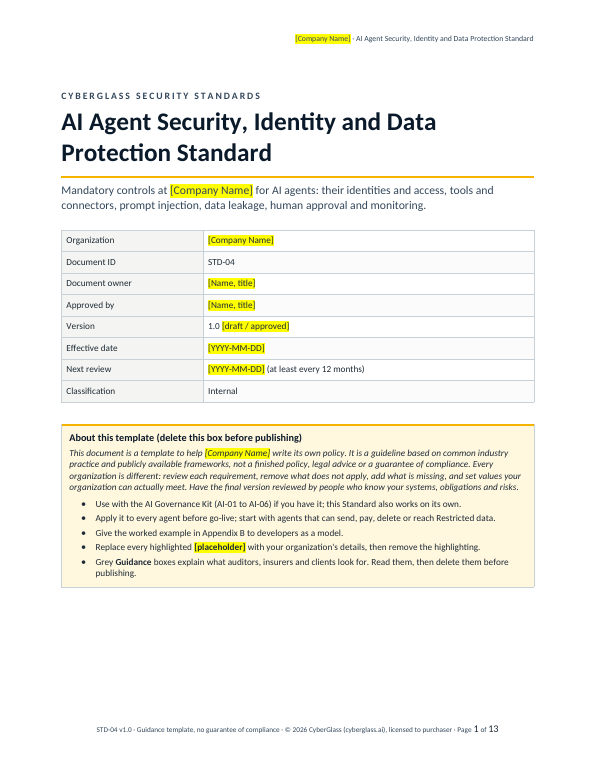
AI Agent Security, Identity and Data Protection Standard

Secure AI agents before they act: own identities and short-lived scoped tokens, tool and tool-server hardening, prompt injection boundaries, data leakage controls and human approval gates.

  • NIST AI RMF 1.0
  • OWASP Top 10 for Agentic Applications
  • NIST CSF 2.0
US$129Details
New
Bundles

Emerging Risks Pack: Identity, AI Agents and Post-Quantum

Three standards for the newest risks: help desk impersonation and mass file theft (STD-03), AI agents acting on your systems (STD-04) and the move to post-quantum cryptography (STD-05).

  • NIST SP 800-63B
  • NIST AI RMF 1.0
  • OWASP Top 10 for Agentic Applications
US$249Details

Use alongside your own licensed copy of the standard. CyberGlass does not sell or reproduce standard text.

Based on NIST CSF 2.0. Republished courtesy of the National Institute of Standards and Technology. NIST does not endorse CyberGlass.